CompTIA CySA+ (CS0-003) Practice Questions & Study Guide
# Complete Study Guide for the CompTIA CySA+ (CS0-003) Exam
The CompTIA Cybersecurity Analyst (CySA+) is an intermediate-level certification designed to validate the knowledge and skills required to proactively monitor, detect, and respond to cybersecurity threats. Whether you are a security analyst, a threat intelligence researcher, or an incident responder, this certification proves your ability to handle the challenges of modern cybersecurity operations.
## Why Pursue the CompTIA CySA+ Certification?
In an era of increasingly sophisticated cyber threats, organizations need highly skilled security analysts to protect their data and systems. Earning the CySA+ badge demonstrates that you:
- Can leverage intelligence and threat detection techniques to monitor and protect enterprise networks.
- Understand the technical aspects of security monitoring and how to apply them to identify potential threats.
- Can analyze security risks and develop mitigation strategies.
- Understand the legal and regulatory requirements for data security and incident response.
- Can provide technical guidance on security-related projects.
## Exam Overview
The CompTIA CySA+ (CS0-003) exam consists of multiple-choice and performance-based questions. You are given 165 minutes to complete the exam, and the passing score is typically 750 out of 900.
### Key Domains Covered:
1. **Security Operations (33%):** This domain focuses on your ability to monitor and protect enterprise networks using intelligence and threat detection techniques.
2. **Vulnerability Management (18%):** Here, the focus is on identifying and managing security vulnerabilities. You must understand vulnerability scanning, assessment, and remediation.
3. **Incident Response and Management (25%):** This section covers your knowledge of incident response and management techniques. You'll need to understand how to handle and resolve security incidents.
4. **Reporting and Communication (24%):** This domain tests your ability to report and communicate security findings to various stakeholders. You must understand different types of documentation and how to follow them.
## Top Resources for CySA+ Preparation
Successfully passing the CySA+ requires a mix of theoretical knowledge and hands-on experience. Here are some of the best resources:
- **Official CompTIA Training:** CompTIA offers specialized digital and classroom training specifically for the CySA+ certification.
- **CySA+ Study Guide:** The official study guide provides a comprehensive overview of all the exam domains.
- **Hands-on Practice:** There is no substitute for building and managing security monitoring solutions. Set up your own home lab and experiment with different security monitoring tools and techniques.
- **Practice Exams:** High-quality practice questions are essential for understanding the intermediate-level exam format. Many candidates recommend using resources like [notjustexam.com](https://notjustexam.com) for their realistic and challenging exam simulations.
## Critical Topics to Master
To excel in the CySA+, you should focus your studies on these high-impact areas:
- **Security Monitoring and Threat Detection:** Master the nuances of monitoring and protecting enterprise networks using intelligence and threat detection techniques.
- **Vulnerability Management and Assessment:** Understand vulnerability scanning, assessment, and remediation techniques.
- **Incident Response and Handling:** Know how to handle and resolve security incidents using various techniques and tools.
- **Security Reporting and Communication:** Master the principles of reporting and communicating security findings to various stakeholders.
- **Security Analytics and Intelligence:** Understand how to use security analytics and intelligence to identify potential threats.
## Exam Day Strategy
1. **Pace Yourself:** With 165 minutes for the exam, you have ample time. If a question is too complex, flag it and move on.
2. **Read the Scenarios Carefully:** Intermediate-level questions are often scenario-based. Pay attention to keywords like "most likely," "least likely," and "best way."
3. **Use the Process of Elimination:** If you aren't sure of the right choice, eliminating the wrong ones significantly increases your chances.
## Conclusion
The CompTIA Cybersecurity Analyst (CySA+) is a significant investment in your career. It requires dedication and a deep understanding of security principles and analytical skills. By following a structured study plan, leveraging high-quality practice exams from [notjustexam.com](https://notjustexam.com), and gaining hands-on experience, you can master the complexities of security operations and join the elite group of certified cybersecurity analysts.
Free CompTIA CySA+ (CS0-003) Practice Questions Preview
-
Question 1
A recent zero-day vulnerability is being actively exploited, requires no user interaction or privilege escalation, and has a significant impact to confidentiality and integrity but not to availability. Which of the following CVE metrics would be most accurate for this zero-day threat?
- A. CVSS:31/AV:N/AC:L/PR:N/UI:N/S:U/C:H/I:K/A:L
- B. CVSS:31/AV:K/AC:L/PR:H/UI:R/S:C/C:H/I:H/A:L
- C. CVSS:31/AV:N/AC:L/PR:N/UI:H/S:U/C:L/I:N/A:H
- D. CVSS:31/AV:L/AC:L/PR:R/UI:R/S:U/C:H/I:L/A:H
Correct Answer:
A
Explanation:
I agree with the community and suggested answer of Option A. Although there is an apparent typographical error in the vector string (using
Reason
Option A is the most accurate choice because it satisfies the fundamental constraints given in the scenario. "PR:N" represents Privileges Required: None, aligning with
Why the other options are not as suitable
- Option B is incorrect because it specifies PR:H (Privileges Required: High) and UI:R (User Interaction: Required), both of which directly contradict the prompt's explicit statement that the vulnerability requires no user interaction or privilege escalation. It also contains invalid metric keys such as "AV:K".
- Option C is incorrect because it specifies UI:H, which is not a valid CVSS v3.1 value for User Interaction (only N or R are valid), and indicates a low impact on confidentiality (C:L) and high impact on availability (A:H), contradicting the prompt.
- Option D is incorrect because it specifies PR:R (which is not a valid CVSS v3.1 value for Privileges Required, as it uses N, L, or H), requires user interaction (UI:R), and indicates high availability impact (A:H), failing multiple conditions of the scenario.
Citations
-
Question 2
Which of the following tools would work best to prevent the exposure of PII outside of an organization?
- A. PAM
- B. IDS
- C. PKI
- D. DLP
Correct Answer:
D
Explanation:
I agree with the community and suggested answer that DLP (Data Loss Prevention) is the correct choice. It is specifically engineered to detect, monitor, and block unauthorized egress of sensitive data like Personally Identifiable Information (PII) beyond the corporate boundary.
Reason
Option D is correct because DLP (Data Loss Prevention) software scans networks, endpoints, and storage repositories to identify and prevent the unauthorized transmission of sensitive information. It relies on content awareness and inspection policies to detect patterns matching PII (such as Social Security numbers or credit card details) and can block these data blocks from being emailed, uploaded, or copied externally.
Why the other options are not as suitable
- Option A is incorrect because PAM (Privileged Access Management) focuses on securing, controlling, and monitoring elevated access and credentials for administrative accounts, rather than inspecting outbound data content for PII leakage.
- Option B is incorrect because an IDS (Intrusion Detection System) monitors network traffic for malicious activity or policy violations to alert administrators about external attacks or insider threats, but it does not natively possess the granular data-classification and outbound enforcement capabilities needed to prevent PII exfiltration.
- Option C is incorrect because PKI (Public Key Infrastructure) provides the framework for managing digital certificates and public-key encryption to guarantee confidentiality and authentication, but it does not proactively inspect files to block the accidental or malicious transfer of unencrypted PII.
Citations
-
Question 3
An organization conducted a web application vulnerability assessment against the corporate website, and the following output was observed:
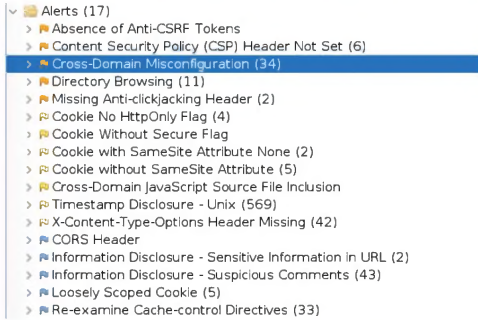
Which of the following tuning recommendations should the security analyst share?
- A. Set an HttpOnly flag to force communication by HTTPS
- B. Block requests without an X-Frame-Options header
- C. Configure an Access-Control-Allow-Origin header to authorized domains
- D. Disable the cross-origin resource sharing header
Correct Answer:
C
Explanation:
I agree with the selected answer of C. The vulnerability assessment image highlights a Cross-Domain Misconfiguration alert. In web application security, this finding refers directly to misconfigured Cross-Origin Resource Sharing (CORS) headers, which are mitigated by restricting permissions to trusted origins rather than using risky wildcards.
Reason
Option C is correct because a Cross-Domain Misconfiguration indicates that the web server is overly permissive with resource sharing across different origins. Properly configuring the Access-Control-Allow-Origin header to whitelist only explicitly authorized domains ensures that malicious external domains cannot access sensitive data or execute cross-domain actions via an authenticated user's browser.
Why the other options are not as suitable
- Option A is incorrect because the HttpOnly flag prevents client-side scripts from accessing cookies to mitigate cross-site scripting (XSS) attacks; it does not force communication over HTTPS (which is handled by the Secure flag or HSTS).
- Option B is incorrect because blocking requests missing an X-Frame-Options header deals with mitigating clickjacking attacks rather than rectifying a cross-domain sharing policy.
- Option D is incorrect because completely disabling the cross-origin resource sharing header can break required modern application functionalities that legitimately depend on APIs hosted across separate subdomains or trusted third-party origins.
Citations
-
Question 4
Which of the following items should be included in a vulnerability scan report? (Choose two.)
- A. Lessons learned
- B. Service-level agreement
- C. Playbook
- D. Affected hosts
- E. Risk score
- F. Education plan
Correct Answer:
DE
Explanation:
I agree with the community and suggested answer of D and E. A vulnerability scan report must provide actionable and context-specific data to help administrators prioritize and patch issues, which inherently requires knowing which devices are impacted and how severe the risk is.
Reason
Affected hosts (Option D) is correct because remediation teams need to know exactly which IP addresses, hostnames, or assets contain the vulnerability to target their patching efforts. Risk score (Option E) is correct because it allows organizations to prioritize vulnerabilities based on severity (such as CVSS scores), ensuring that critical flaws are addressed before low-risk items.
Why the other options are not as suitable
- Option A is incorrect because Lessons learned is a phase associated with incident response or post-incident reviews, not a standard component generated by a vulnerability scanner.
- Option B is incorrect because a Service-level agreement is a legal or contractual document defining performance standards between a provider and a customer, not an element of a technical scan report.
- Option C is incorrect because a Playbook provides a step-by-step standard operating procedure for responding to specific security incidents or threats, rather than being part of a scan report. Option F is incorrect because an Education plan details employee training initiatives and is part of a broader security awareness program, not an output of a technical vulnerability assessment.
Citations
-
Question 5
The Chief Executive Officer of an organization recently heard that exploitation of new attacks in the industry was happening approximately 45 days after a patch was released. Which of the following would best protect this organization?
- A. A mean time to remediate of 30 days
- B. A mean time to detect of 45 days
- C. A mean time to respond of 15 days
- D. Third-party application testing
Correct Answer:
A
Explanation:
I agree with the suggested answer A. The scenario describes a specific window of exposure: attacks actively exploit newly discovered vulnerabilities roughly 45 days after a patch becomes available. To mitigate this vulnerability window proactively before exploits occur, the organization must fully apply the patch across its environment. A mean time to remediate (MTTR) of 30 days guarantees that patches are completely deployed 15 days before the typical threat window opens.
Reason
Option A is correct because remediation explicitly refers to fixing the root cause of a security vulnerability (such as applying software patches or modifying configuration baselines). Since the organizational goal is to ensure patches are fully operational before the 45-day exploitation cycle begins, adopting a metric that enforces complete patch remediation within 30 days successfully protects the environment.
Why the other options are not as suitable
- Option B is incorrect because a mean time to detect of 45 days is far too slow; it means the organization takes 45 days just to discover an issue or an attack, leaving zero time to fix it before exploitation begins.
- Option C is incorrect because mean time to respond typically quantifies initial incident response triage activities (such as isolation, containment, or logging) after an active exploit or security alert is detected, rather than the proactive structural distribution of software patches to resolve underlying security vulnerabilities.
- Option D is incorrect because third-party application testing is an audit or assessment capability designed to find programming flaws; it does not dictate or accelerate the patch deployment schedule required to resolve known vendor-released updates.
Citations
-
Question 6
A security analyst recently joined the team and is trying to determine which scripting language is being used in a production script to determine if it is malicious. Given the following script:

Which of the following scripting languages was used in the script?
- A. PowerShell
- B. Ruby
- C. Python
- D. Shell script
Correct Answer:
A
Explanation:
I agree with the chosen answer, which is A. PowerShell. The provided script explicitly utilizes the Verb-Noun cmdlet structure (such as Get-ADUser, Add-ADGroupMember, and Set-ADUser) along with standard PowerShell pipeline syntax (|) and variables prefixed with the dollar sign ($), which are definitive identifiers of PowerShell.
Reason
Option A is correct because the syntax features standard PowerShell cmdlets (like Get-Content and Get-ADUser), loops (foreach), and Active Directory object manipulation commands designed for Windows-based administration frameworks.
Why the other options are not as suitable
- Option B is incorrect because Ruby does not use Verb-Noun cmdlets with hyphens or the Get-Content command structure to process files and objects.
- Option C is incorrect because Python relies on indentation for block definition, utilizes keywords like 'for user in ...:', and requires specialized modules like 'pyad' or 'ldap3' rather than native cmdlet structures.
- Option D is incorrect because a standard Unix Shell script (such as Bash) utilizes a different structure for loops (like 'for user in ...; do ... done') and handles commands via native binaries rather than Windows-specific cmdlet naming conventions.
Citations
-
Question 7
A company's user accounts have been compromised. Users are also reporting that the company's internal portal is sometimes only accessible through HTTP, other times; it is accessible through HTTPS. Which of the following most likely describes the observed activity?
- A. There is an issue with the SSL certificate causing port 443 to become unavailable for HTTPS access
- B. An on-path attack is being performed by someone with internal access that forces users into port 80
- C. The web server cannot handle an increasing amount of HTTPS requests so it forwards users to port 80
- D. An error was caused by BGP due to new rules applied over the company's internal routers
Correct Answer:
B
Explanation:
I agree with the community and suggested answer of Option B. The intermittent downgrade from HTTPS to HTTP paired with compromised user accounts strongly indicates an active on-path (man-in-the-middle) stripping attack where credentials are being intercepted.
Reason
Option B is correct because an on-path attacker positioned within the internal network can actively perform SSL/TLS stripping. By intercepting communication, the attacker forces the user's connection to downgrade to unencrypted HTTP (port 80) while maintaining an HTTPS connection with the server. This explains both the compromised accounts (due to cleartext credential harvesting) and why the portal is only sometimes accessible securely.
Why the other options are not as suitable
- Option A is incorrect because a problem with the SSL certificate would typically result in explicit browser security warnings or a total denial of HTTPS access rather than silently dropping users back to an unencrypted HTTP connection.
- Option C is incorrect because a high volume of traffic or resource exhaustion on a web server would cause connection timeouts, 5xx server errors, or crashes, rather than selectively rewriting configuration rules to forward traffic over port 80.
- Option D is incorrect because BGP (Border Gateway Protocol) is an exterior gateway protocol responsible for routing traffic between autonomous systems across the internet; it does not dictate layer 7 protocol properties or port redirection on an internal corporate portal.
Citations
-
Question 8
A security analyst is tasked with prioritizing vulnerabilities for remediation. The relevant company security policies are shown below:
Security Policy 1006: Vulnerability Management
1. The Company shall use the CVSSv3.1 Base Score Metrics (Exploitability and Impact) to prioritize the remediation of security vulnerabilities.
2. In situations where a choice must be made between confidentiality and availability, the Company shall prioritize confidentiality of data over availability of systems and data.
3. The Company shall prioritize patching of publicly available systems and services over patching of internally available system.
According to the security policy, which of the following vulnerabilities should be the highest priority to patch?
- A. Name: THOR.HAMMER -CVSS:3.1/AV:N/AC:L/PR:N/UI:N/S:U/C:N/I:N/A:HInternal System
- B. Name: CAP.SHIELD -CVSS 3.1/AV:N/AC:L/PR:N/UI:N/S:U/C:H/I:N/A:NExternal System
- C. Name: LOKI.DAGGER -CVSS:3.1/AV:N/AC:L/PR:N/UI:N/S:U/C:N/I:N/A:HExternal System
- D. Name: THANOS.GAUNTLET -CVSS:3.1/AV:N/AC:L/PR:N/UI:N/S:U/C:H/I:N/A:NInternal System
Correct Answer:
B
Explanation:
I agree with the community and suggested answer of Option B. The organization's policy dictates a higher priority for vulnerabilities impacting Confidentiality (C:H) over Availability (A:H), and prioritizes externally accessible systems over internal ones. Option B matches all these high-priority criteria perfectly.
Reason
Option B is correct because its CVSS string shows a high impact on confidentiality (C:H), which satisfies Security Policy 1006, Rule 2 stating confidentiality must be prioritized over availability. Furthermore, it resides on an External System, satisfying Rule 3 which mandates prioritizing publicly available systems over internal systems.
Why the other options are not as suitable
- Option A is incorrect because it impacts availability (A:H) instead of confidentiality (C:N) and resides on an Internal System, giving it the lowest priority across both rules.
- Option C is incorrect because despite being an External System, its high impact metric is tied to availability (A:H) rather than confidentiality (C:N), violating Rule 2.
- Option D is incorrect because it resides on an Internal System, meaning it falls behind
- Option B under Rule 3, which explicitly prioritizes external systems when all other metrics are equal.
Citations
-
Question 9
Which of the following will most likely ensure that mission-critical services are available in the event of an incident?
- A. Business continuity plan
- B. Vulnerability management plan
- C. Disaster recovery plan
- D. Asset management plan
Correct Answer:
A
Explanation:
I agree with the suggested answer A. A Business Continuity Plan (BCP) is designed to ensure that mission-critical services and operations continue running with minimal or no disruption during an ongoing incident.
Reason
Option A is correct because a Business Continuity Plan (BCP) focuses on high-level business resilience and contains the protocols necessary to maintain continuous operations and keep mission-critical functions available throughout an adverse event or incident.
Why the other options are not as suitable
- Option B is incorrect because a vulnerability management plan focuses on identifying, prioritizing, and remediating weaknesses within systems before they can be exploited, rather than maintaining operational availability during an active incident.
- Option C is incorrect because a Disaster Recovery Plan (DRP) is a subset of the BCP that focuses specifically on restoring systems and data after a major disruption or disaster has already knocked them offline, rather than ensuring continuous availability during an incident.
- Option D is incorrect because an asset management plan involves tracking, inventorying, and managing physical and digital assets over their lifecycle, which does not directly dictate incident operational availability procedures.
Citations
-
Question 10
The Chief Information Security Officer wants to eliminate and reduce shadow IT in the enterprise. Several high-risk cloud applications are used that increase the risk to the organization. Which of the following solutions will assist in reducing the risk?
- A. Deploy a CASB and enable policy enforcement
- B. Configure MFA with strict access
- C. Deploy an API gateway
- D. Enable SSO to the cloud applications
Correct Answer:
A
Explanation:
I agree with the community and suggested answer of Option A. A Cloud Access Security Broker (CASB) is explicitly designed to solve the problem of shadow IT by discovering unapproved cloud usage, assessing risk, and enforcing security policies across an enterprise's cloud environment.
Reason
Option A is correct because a CASB acts as a security policy enforcement point placed between cloud service consumers and cloud service providers. It is specifically designed to provide visibility into shadow IT, identify high-risk cloud applications being used without authorization, and actively block or restrict traffic to those applications based on enterprise policies.
Why the other options are not as suitable
- Option B is incorrect because configuring MFA (Multi-Factor Authentication) secures authorized corporate identities and access paths, but it does not discover or mitigate the risk of unauthorized shadow IT cloud applications.
- Option C is incorrect because an API gateway manages, secures, and routes API traffic for applications owned or managed by the organization; it cannot monitor or control general employee web traffic to external shadow IT cloud applications.
- Option D is incorrect because enabling SSO (Single Sign-On) centralizes authentication for sanctioned, managed enterprise applications, but it cannot prevent users from bypassing corporate infrastructure to access unapproved, unsanctioned high-risk cloud applications.
Citations
About This Practice Material
This is independent study material to help you prepare for the CompTIA CySA+ (CS0-003) exam. It is not affiliated with, endorsed by, or sponsored by CompTIA or any certification body. All product names, certification names, trademarks, and exam codes are the property of their respective owners and are used here for descriptive (nominative) purposes only.
We do not provide real exam questions, brain dumps, or any guarantee of passing. All questions are original practice items compiled from publicly available community discussions and AI-generated explanations, aligned to the publicly available exam objectives.